Georgia's Open Burn Ban: What Landowners Need to Know Before Clearing Their Property
From April 28 through October 1, open burning of land clearing debris is illegal in Newton, Rockdale, Walton, and 40+ Georgia counties — the exact months most landowners want to clear their property. Forestry mulching is the compliant alternative: one machine pass cuts, chips, and mulches vegetation on-site, leaving no debris to burn, haul, or wait on a legal window to dispose of.
What Georgia's Open Burning Rules Actually Say
There are two separate frameworks that govern open burning in Georgia, and both apply to land-clearing debris:
1. Georgia EPD's Open Burning Rule (Rule 391-3-1-.02)
Georgia's Environmental Protection Division regulates what can and cannot be burned across the state. Under this rule, land-clearing waste — brush, stumps, timber, vegetation — can be burned only in open areas and only under specific conditions. During Georgia's ozone season (April 28 through October 1), open burning of land-clearing debris is prohibited in the 45-county metro Atlanta area and all non-attainment counties. Newton, Rockdale, and Walton counties fall within this restriction zone.
Outside of ozone season, burning may still require a permit from the Georgia Forestry Commission, and the fire must meet setback and notification requirements.
2. Georgia Forestry Commission (GFC) Daily Burn Status
Even when burning is technically legal, the Georgia Forestry Commission publishes a daily burn status by county based on fire weather conditions — wind, humidity, temperature, and drought index. On days when the GFC declares "burning not recommended" or suspends burning permits in your county, you cannot legally burn. In East Georgia, this happens regularly in summer and fall when conditions are dry.
Before any open burn, you are required to:
Check the GFC's daily burn status for your county (1-800-GA-TREES or gfc.state.ga.us)
Hold a valid burning permit (GFC issues them, often same-day, but they can be suspended)
Maintain the fire within 50 feet of the clearing and have suppression equipment on site
Notify the GFC when you begin burning
What You Can't Burn
The burn ban covers the most common materials generated by land clearing:
Brush, vines, kudzu, privet, honeysuckle
Saplings and small trees
Tree tops and limbs from felled timber
Stumps (generally never legal to burn open)
Root balls from grubbing
Household debris, construction waste, and trash are separately prohibited year-round.
Why Forestry Mulching Is the Compliant Alternative
A tracked mulching machine with a rotary drum head cuts, chips, and shreds vegetation in a single pass, leaving the material spread on the ground. For Georgia landowners working under the burn ban, this solves the compliance problem entirely.
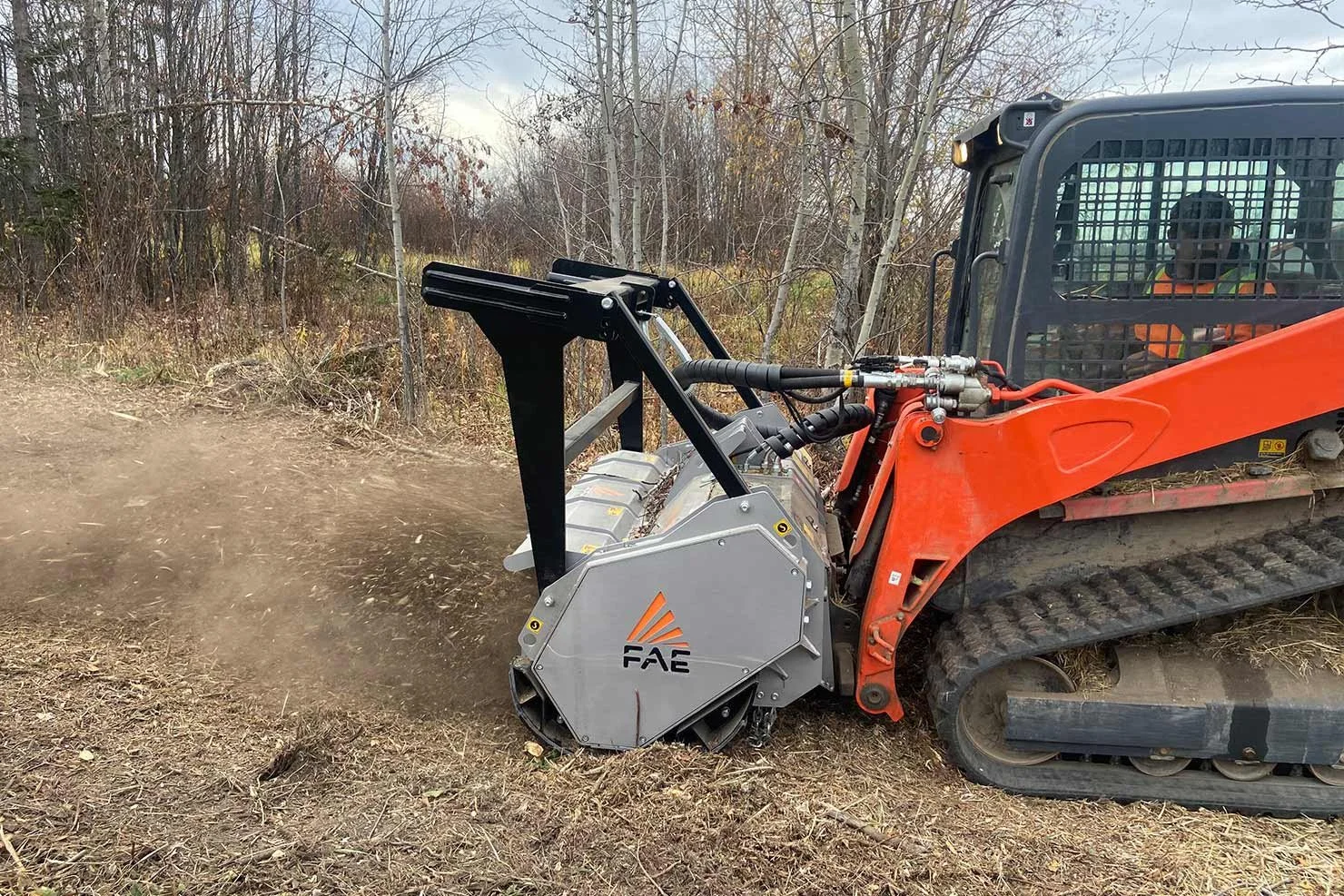
No pile to burn. Nothing to haul. The land is clear the day the machine leaves.
No burn permit needed — nothing is being burned
No waiting for the right weather window — the mulcher works April through October without restriction
GSWCC-compliant — the mulch layer left on site actually helps satisfy Georgia's Erosion and Sedimentation Act requirements for erosion control on disturbed land (any clearing over one acre requires an approved erosion and sediment control plan under Georgia law; mulching is a recognized Best Management Practice)
Faster than burning — a mulcher can clear an acre in hours; burning takes days and requires someone on site the entire time
What Mulching Can and Can't Handle
Forestry mulching handles most of what grows in East Georgia:
Works well:
Kudzu, privet, honeysuckle, and other invasive vines — completely mulched
Brush and undergrowth up to 4–6 inches in diameter
Saplings and small trees up to 8 inches in diameter (with the right machine setup)
Overgrown lots, fence lines, right-of-way corridors
Requires additional work:
Large timber (trees over 8–10 inches in diameter) — these are typically felled and processed separately, with tops and brush then mulched
Stumps from large trees — some stumps can be ground on-site with a separate stump grinder; others may need traditional excavation
For most residential lots, 1–10 acres, overgrown fields, and fence-line or right-of-way clearing, forestry mulching handles the job start to finish.
What It Costs to Mulch Instead of Burn
Forestry mulching in East Georgia typically runs $1,500–$9,000+ per acre, depending on vegetation density and terrain. That breaks down roughly as:
Light growth (brush, kudzu, privet under 3 inches): $1,500–$3,000/acre
Mixed growth (a mix of brush, saplings, and trees under 8 inches): $3,000–$6,000/acre
Heavy timber with dense understory: $6,000–$9,000+/acre
These are per-acre estimates — we give you a firm price after walking the property. No surprises.
ASG Dirtworx serves Newton, Rockdale, Walton, Morgan, Henry, and surrounding East Georgia counties from our base in Covington, GA. We're GSWCC-certified (Georgia Soil and Water Conservation Commission), OSHA-certified, and a registered 811 Contractor.
Call (770) 318-1032 to schedule an on-site estimate.
Frequently Asked Questions
Can you burn brush in Georgia right now?
It depends on the time of year and your county. From April 28 through October 1, open burning of land clearing debris is prohibited in Newton, Rockdale, Walton, and all non-attainment counties under Georgia's EPD ozone season rule. Outside that window, you may burn with a Georgia Forestry Commission permit, but the GFC can suspend burning on any given day based on fire weather conditions. Check the daily burn status at 1-800-GA-TREES before lighting any fire.
Is forestry mulching compliant during Georgia's burn ban?
Yes. Forestry mulching involves no fire and produces no smoke — the machine grinds vegetation into mulch on-site. There are no permit requirements for the mulching itself, and the mulch layer left on the ground is recognized as a Best Management Practice for erosion control under Georgia's Erosion and Sedimentation Act.
What happens if you burn land-clearing debris illegally in Georgia?
Burning land clearing debris without a permit, outside of allowed windows, or during a GFC permit suspension is a violation of Georgia EPD regulations and can result in civil penalties. The fine depends on the specific violation and whether it caused smoke complaints or fire spread. It's not worth the risk — especially when mulching clears the same land faster and legally.
How do I clear 10 acres in Georgia without burning?
Forestry mulching is the standard approach for 1–20 acre residential clearing projects in East Georgia. A tracked mulcher can cover 1–3 acres per day depending on growth density, and the finished site is clear, mulched, and ready for the next phase with no debris left behind. For larger tracts or projects requiring timber harvest, a combination of conventional logging (for merchantable timber) and forestry mulching (for tops, brush, and understory) is common.
Does forestry mulching count as erosion control under Georgia law?
The mulch layer left on site after a forestry mulching job acts as natural erosion protection and is recognized as a Best Management Practice by the Georgia Soil and Water Conservation Commission. For any land-disturbing activity over one acre, you still need an erosion and sediment control plan that meets GSWCC standards — but mulching contributes to meeting that requirement. ASG Dirtworx is GSWCC-certified and handles erosion control compliance on qualifying jobs.