What's My Timber Worth? Straight Answers for Georgia Landowners
Almost every time I bid on a clearing job, somebody asks me how much they can get for the timber. On a typical residential lot or small clearing job in Georgia right now, the answer is close to nothing. Sometimes it costs more to load and haul the logs than a buyer will pay.
The published market numbers back that up.
Standing price vs. mill price
Timber has two prices.
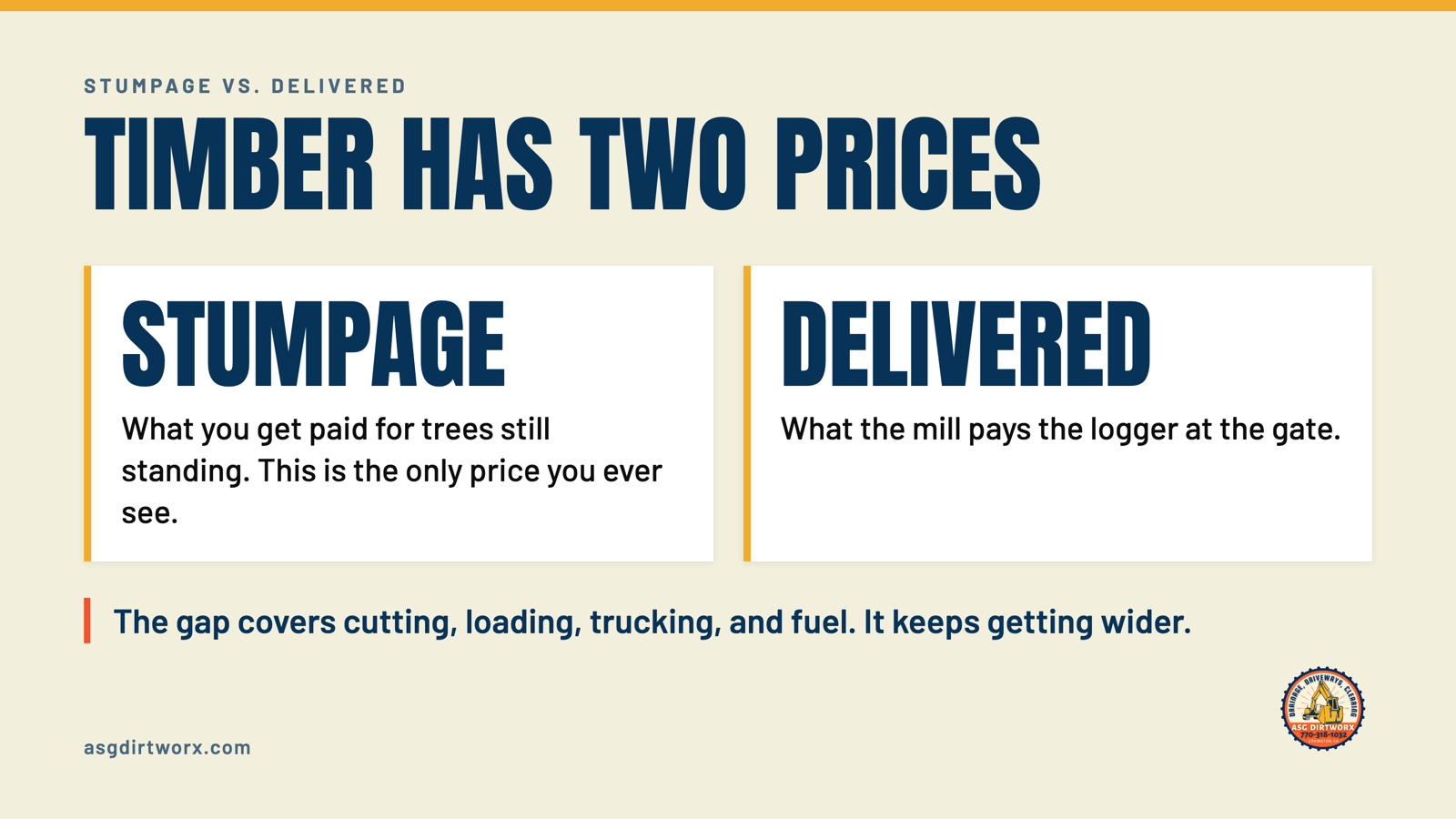
Stumpage is what a landowner gets paid for trees still standing on the property. A logger buys them, cuts them, loads them, and hauls them. Delivered is what the mill pays that logger at the gate. You only ever see the stumpage price. The difference covers cutting, loading, trucking, and fuel.
That gap has been getting wider. UGA's forestry researchers blame inflation and Georgia losing loggers. With diesel where it is this year, I don't expect it to shrink anytime soon.
What the numbers say right now
Standing timber is priced by the ton. These are the latest published averages, covering mid-2025 through June 2026. I pulled them together in October 2026.
Covington and most of the metro sit in the North Georgia market, which has been running weaker than South Georgia. Pulpwood is the worst of it. In North Georgia, pine pulpwood dropped 18%, and hardwood pulpwood dropped 27% in a single year, per UGA's 2025 numbers. The longer slide is bigger. By late 2025, pine pulpwood across the South was 46% below its 2022 peak and hardwood pulpwood was 33% below its 2022 peak, according to Southern Ag Today.
By my rough guess, a good-sized, straight pine might bring $25 to $35 standing, and a pulpwood-sized tree a few dollars. That's if a logger is willing to come out.
Red oak and white oak
Good hardwood logs sell to sawmills by the board foot, and the log grade decides almost everything. I couldn't find a Georgia mill that publishes its prices, so the closest real example I have is Sunrise Sawmill in Asheville, NC. They pay 10 to 30 cents a board foot for red oak and 10 cents to $1.25 for white oak, depending on grade, delivered to their yard. Georgia mills likely pay at or below that.
A clean 20-inch red oak log, 12 feet long, scales about 190 board feet. At a middle grade, that's roughly $40, delivered to the mill. The same log in good white oak might bring $100 to $190. A typical yard oak with limbs, knots, and some rot is usually bottom grade, which puts it around $10 to $20 a log.
White oak is the one species worth asking about. If you've got big, straight white oaks with no low limbs, give me a heads up before we start.
Why yard trees bring even less
Trees that grew near a house or a fence line usually have metal in them. Nails, fence wire, clothesline hooks, old deer stand bolts. One nail can wreck a sawmill blade, so many mills won't buy residential logs at all. The ones that will tend to pay pallet price.
Volume is the other problem. Loggers make their money on a full crew and steady loads. Moving their equipment in for a handful of trees on an acre or two doesn't pencil out, so most won't come. Mills and wood yards usually want full truckloads too.
When your timber is worth something
Suppose you've got 10 acres or more of real timber, the math changes. Before you hire anybody to clear it, call a registered consulting forester. They work for you, cruise the timber, and put it out for bids, so loggers compete for it. The Georgia Forestry Commission can point you to one.
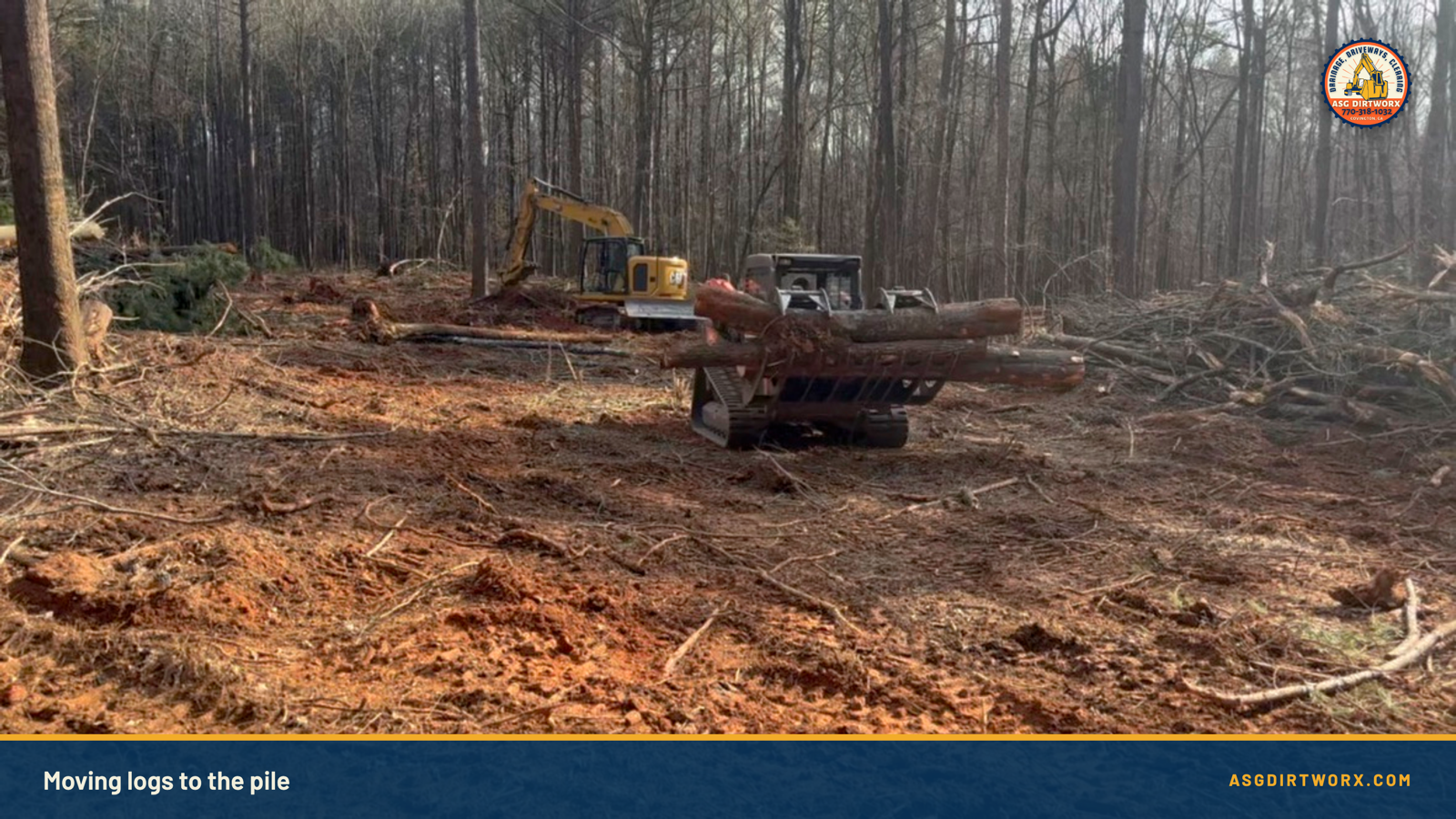
On a tract like that, the smart order is to have it logged first and get paid for the merchantable wood. Then I come in and mulch what's left. Less material on the ground usually means a smaller clearing bill from me too.
What this means for your job
On most lots I clear, I pile the logs and stumps and mulch the slash. If we're allowed to burn on your property, we burn the pile. If you want to keep some logs for firewood or try selling them yourself, that's fine. Tell me when I'm bidding the job so I can plan for it.
A small lot is still worth clearing. The timber was never going to pay for the work. You're paying for usable ground, whether that's a house site, a pasture, a garden, or a yard you can finally mow. I'll give you a fair number on the clearing and a realistic answer on the wood, and you decide from there.
If you're not sure what you've got, send me a few photos or have me walk it with you. I'll tell you whether it's worth calling a forester.
-Cujo